Panther Pedagogy
By Stan Doyle-Wood & Dante Barksdale
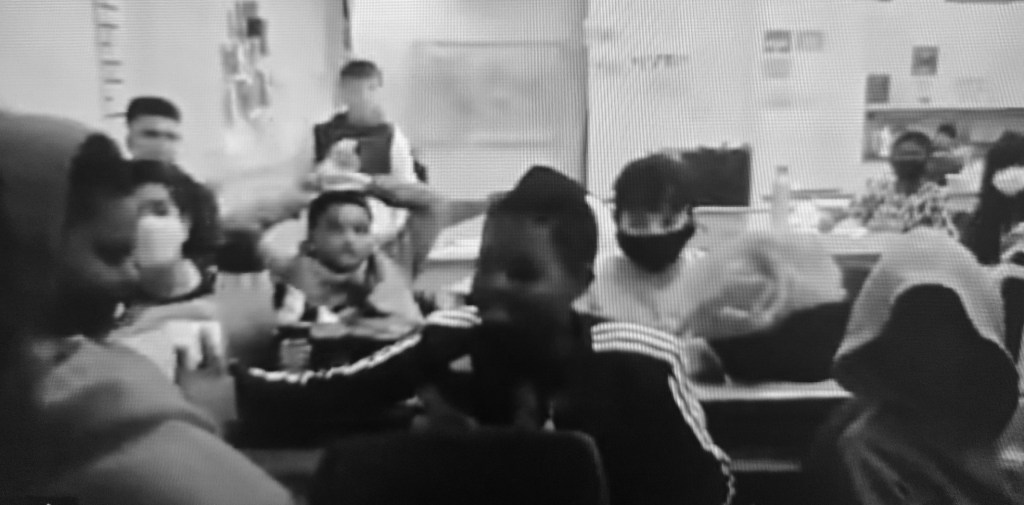
Comrade and sister in the struggle Elaine Brown started this historic session in the Canadian education system with a single observation and a single question. Aware that our grade 5 and 6 eleven-year-old comrades and skolaz were developing some strong knowledge about the Panthers and what education for liberation and freedom should be and what it aint, she said, “I know you have heard of the Black Panther Party….but the question I have for you is why do you think there was a Black Panther Party in the first place?”
Comrade Brown waited a little and then answered her own question by telling the story of the Panthers and why and when they began. Not in 1966 as many people would have said but from Huey and Panther pedagogy’s point of view that in reality the Black Panther Party started in the 1600s when the first enslaved peoples of African ancestry in North America and Turtle Island put up resistance and fought back. Talking about the why, when, and resistance, comrade Brown told our comrades about the Panther’s Ten Point Program and so the story of the Panthers became the story of the Ten Point Program and the story of both became the story of Black liberation and the long struggle for liberation and freedom on the part of all oppressed peoples from a system of enslavement, exploitation and colonial oppression back then and in the now.
We’re gonna be showing this first part of the session soon in a coming edition but for now what we want to showcase is the second part, the part where our young comrades and skolaz put questions to one of the most legendary figures in the global revolutionary struggle. We feel that It is necessary to point out that these questions which, in their sophistication, depth of knowledge, importance and complexity would not have been out of place in a university classroom, weren’t put together by adults and forced onto our comrades, neither were they put together quickly to impress or please comrade Brown like some kind of show so that when she was gone our comrades might forget them and move onto something else. No these questions were formed collectively over months of steady and consistent coming to revolutionary consciousness work. They were formed through their learning, through their interactions with one another, through their struggles, through and in conflict and hurt and anger, through joys and inspirations, through play, through the doing and the practice of everyday life itself that tied everything to the colonial context and in that doing all are unified, all are comrades. No one is hurting another, no one is harming another, and within a system that has alienated them or disconnected them from everything around them, or created anxieties in them, no one is now trying to survive or trying to gain a sense of refuge or self and identity by competing with another or dominating another or shaming another, or putting another down.
ALL now are a family. ALL now are comrades. ALL now are a collective, an anticolonial collective. And as an anticolonial collective all now know and believe that not only are they inseparably connected to each other and to everything around them (and will defend themselves and their WHOLE selves along those lines) but that they have power. And this is revolutionary love. Its like what Huey told us, that unity comes with consciousness. The more consciousness that’s revolutionary that we as oppressed peoples gain the more unified we become. That’s Panther pedagogy. Its like what the great anticolonial fighter and skola Amilcar Cabral once said, that action produces theory, it produces knowledge, our knowledge. The questions that our comrades ask of comrade Brown come into existence in part because of the knowledge that our comrades and their revolutionary learning space has produced, so when we use the term ‘skolaz’ to describe our grade 5/6 comrades we doh make joke.
When we produce knowledge then, when we grow knowledge, we do it not as individuals but as a collective. So to repeat ourselves, every time one of our comrades here puts a question to comrade Brown like for example A’s question about the Panther’s justice committee, or J’s question about ‘government schools’ these are questions that have been formed by the whole class as a community and as a collective and this learning has brought with it a new collective language, a new collective way of talking, a new collective way of thinking, a new collective way of relating to one another, and a new collective way of being that will never be forgotten. But its more than this. This knowledge that comes from action – like forming their own justice committees or justice circles that allows our comrades to develop emotional honesty and self-determination, that allows them to speak their truths or to give voice to the things inside that may have previously been denied expression or may have been forced into a kind of silence by the messages and signals that whirl around them that tell them that their experiences or what they know and feel, or the contradictions that they see in their world, or the opinions they have has no value, or is worth-less – comes from the beautiful liberating process of reclaiming the revolutionary knowledge that has gone before them, knowledge that has been produced by the historically oppressed in the struggle for self-determination and freedom. This revolutionary knowledge that is not frozen in any past historical time or place but is alive and living like fire in the now and in their presence.
And everyone is of the same understanding whether we’re in-person or online, everyone collectively and intergenerationally feels it in different ways and even if we dont yet have the language to express it, we feel it, coz its right there, right here in the spirituality of this intercommUNITY space, this feeling, this knowing, THAT although we are here in the presence of comrade Elaine Brown we’re in the presence of not just an individual member of the liberation movement but a move-ment of collective revolutionary knowledge that’s carried by her body and carried in her body and passed onto us and passed into us like how when comrade Brown tells us about how she’d talked to her revolutionary comrade former SNCC (Student Nonviolent Coordinating Committee) chairman and former Panther Jamil Abdullah al-Amin (previously known as H-Rap Brown) in prison who from this place of vicious incarceration had given her revolutionary hope when she was in a moment of despair by telling her how ‘it is inevitable that the pendulum will swing our way” and its like how she then repeats it to us and passes it onto us and it then passes into us to give us revolutionary hope in the struggle and when we feel it and witness it in our bones we know for real that that’s what they cant kill. We know for real now that they can imprison the revolutionary and they can kill the revolutionary but they cant kill the revolution. And when we witnessed this we not only witnessed the communication of revolutionary knowledge going from Fred Hampton to Jamil Abdullah al-Amin to Elaine Brown we witnessed the political becoming of ourselves as a collective of comrades and partners in that communication and in the revolution itself. That’s Panther pedagogy.
Copyright (C) 2025 by Stan Doyle-Wood & Alok Premjee:
All rights reserved.
The Protege Panther Project for Self-Defense
EVERY ATOM OF POWER TO EVERY ATOM OF THE PEOPLE
 The Protege Panther Project for Self-Defense