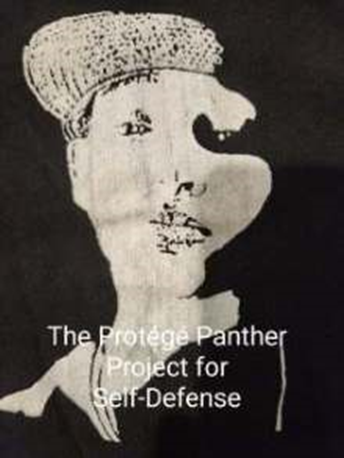
“And in the final analysis, justice depends solely upon the level of our resistance and that the less we resist the less justice we shall have. Therefore we must understand, them that resist shall get, them that don’t shall lose.” This quote reprinted from an article by ‘Jymbo’ entitled, ‘Milton Earl: A Victim of the Fascist Judicial’ . First published in The Black Panther: Black Community News Service, Vol IV, No 28, p.9. Saturday June 13th, 1970.
The Pedagogy of Self-Defense
By Stan Doyle-Wood
Its when you begin to realize the concept of (anticolonial) self-defense that the revolution begins.
The Protégé Panther Project for Self-Defense (PPPSD) is a revolutionary pedagogical initiative and intervention grounded in the concept of self-defense against oppression in all its colonial and imperialistic forms. Self-defense is foundational to everything that we are, everything that we do, and everything that we are committed to do. Self-defense is our anchor. We draw our inspiration from the pedagogies, knowledges and practices of the Black Panther Party for Self-Defense, co-founded in the United States by Huey P. Newton and Bobby Seale in 1966. The Black Panther Party eventually dropped self-defense from its name but this concept and principle nevertheless remained at the core of the Panther’s philosophy, collective personality and commitment to the People.
It remained for example in the image of the charging black panther cat borrowed from the Lowndes County Freedom Organization in Alabama. Bobby Seale in his autobiography Seize the Time (1970), talked about how in the beginning of the Panther’s emergence as a political organization Black community members would ask, “why do you want to be a vicious animal like a panther and “Huey would break in” to remind the people that “the nature of a panther” is self-defense but with the power to fight-back if necessary. The panther, according to Huey, ‘never attacks’, but if the panther is attacked or backed into a corner, “the panther comes up to wipe that aggressor or that attacker out, absolutely, resolutely, wholly, thoroughly and completely”.
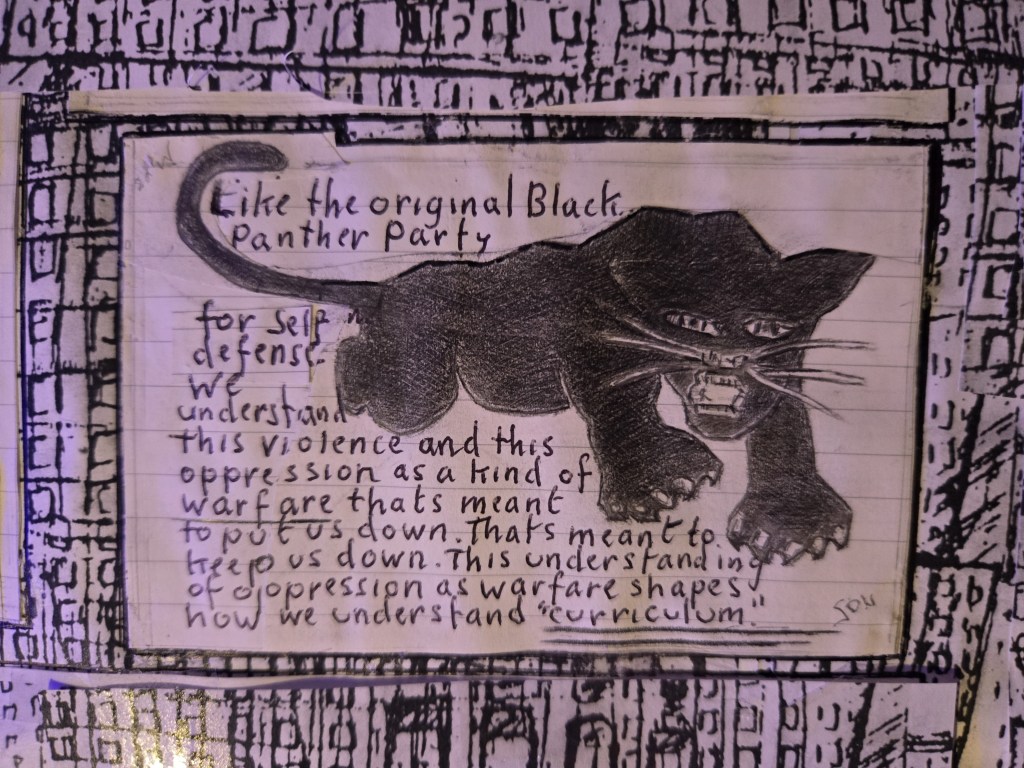
Self-defense remained as the Panther’s central organizing strategy against oppression. Self-defense for the Panthers meant self-defense against State terror, violence and oppression. It meant self-defense against colonialism and imperialism. Self-defense against violence to the land and to water, self-defense against police brutality, self-defense against incarceration, and the prison industrial complex, self-defense against poverty, self-defense against exploitation, self-defense against the denial of healthcare, self-defense against the denial of shelter, self-defense against dispossession, self-defense against the imposition of White, colonial constructions of race, gender, disability, sexuality and class, and by extension, self-defense against those education systems that do violence, that racialize, oppress, alienate, dis-intact, disintegrate, hurt and abuse the children, youth and families of the oppressed.
The Panthers spoke to the violence of education from early on as youth revolutionaries. They understood it from their own personal experiences of the education system as Black children. They knew it from seeing the physical, psychological, emotional and spiritual death toll it took on their peers and their families. In his autobiography Revolutionary Suicide (1973), Huey tells the story of James Crawford, his friend in junior high. Like all of those around him who were Black and racialized, James had dreams: “He dreamed of becoming a great singer. There were days when Melvin and I [Huey’s older brother] sat listening for hours while James sang in his beautiful tenor voice. He was also a good cook and dreamed of opening a restaurant. James Crawford was talented, but the educational system and his psychological scars held him back. He never learned to read. His fear of failure was reinforced rather than helped by those charged with his education, and his dreams slipped away. As he became more fearful and frustrated with each passing year, James was finally expelled from school as an ‘undesirable’. Gradually he sank into alcoholism and has been in and out of state mental hospitals since our school years. His face is scarred where the police beat him. That is the story of my friend James Crawford; another dream blown to hell.”
By the time Huey had been pushed out of the education system he couldn’t read either. Like James and his peers, he actively opposed and resisted learning of any kind in the schools that he was forced to attend. And why not? When all the books and all the reading materials along with the entire curriculum was racist and colonial in everything it stood for and everything it said and everything it did. Why not? When the curriculum humiliated Black girl and boy childs, when it dismissed and derided the knowledges that they brought to the classroom, when it nurtured a ‘sense of despair and futility’, when it forced Black and racialized students into believing they could not learn or they could not think or that they should accept themselves as inferior compared to Whites, or when it forced Black, Brown, Indigenous and racialized students into accepting this ‘inferiority as inevitable and inescapable’. Why not? How else to defend yourself but refuse, reject and oppose even when that legitimate, righteous and logical resistance and anger is criminalized, damned and met with punishment at every which-way you turn? In Huey’s words, ‘rebellion was the only way we knew to cope with the suffocating, repressive atmosphere that undermined our confidence’.
Our unwavering focus is self-defense in collective terms. We are anti-racist and anti-colonial educators. We oppose, rebel and fight-back against all things that are racist. We oppose, rebel and fight-back against all things that are colonial. Education is where we work to intervene, to rebel, to revolt, to take-up self-defense and to fight-back panther style in defense of our children, youth and communities and in defense of their future. We believe that education in its institutional and systemic state-led form is fundamentally racist and colonial in nature and in practice: It abuses, humiliates, punishes, alienates, dehumanizes and brings long lasting pain and hurt to all students but specifically to students who are Indigenous, who are Black, who are Brown, who are racialized, who are poor, and by extension it works to do the same to their/our families and to their/our communities and to the oppressed as a whole. It kills and tramples on their dreams. To borrow from the revolutionary leader Ernesto ‘Che’ Guevara, it despoils. It produces mental and whole-bodied unwellness. We have seen this. We have known this. We have seen and known that sparkle in the eyes of young, racialized children from the moment they come into the world. We have heard laughter, inquisitiveness and love for life radiate from them and we have been moved and we have shed tears of joy , a joy fueled by love, but then, as we have continued to watch them grow older, as the weight of racism, racialization, racial capitalism, racial policing, colonialism and the violence of capitalistic market driven thought, practice and pressure presses down on them, presses in on them, brutalizes them and marks them as a problem, as deficient, as disposable as worthless, as violent, as not belonging, we have watched, with a sickening gut-churning-anger-filled pain, that brightness, that sparkle, that laughter, that love for life, that inquisitiveness, slowly fade as their dreams and aspirations are not just crushed but are murdered by these racist, colonial systems and structures of power that force themselves upon them and force themselves into them.
And we know this. We know this because we as Black, Indigenous, Brown and racialized identifying peoples when we were children and youth we too experienced this same violence ourselves directly at the hands of these racist, colonial/colonizing schooling systems. We have experienced it personally up-close, and our bodies, in their blood and in their bones, continue to carry, speak and sing the painful memory of those experiences or what is often talked about as trauma but rarely talked about or theorized in ways that can enable us to legitimize, embrace, love, politicize and then weaponize this same pain and these wounds as a means and method for educating our individual and collective bodies towards revolutionary consciousness, revolutionary love, revolutionary action and an all encircling collectively interconnected everyday anti-colonial and anti-imperialistic way to live and be. And because of these experiences and as a consequence of our struggles, we carry a revolutionary kind of blood-anger in our bones and in the blood-memory of our bodies that drives and fuels our thinking and our action and therefore our pedagogy in our fight to oppose, defend and fight back collectively against oppression wherever, whenever and however it shows itself and speaks.
“But when you stay radical long enough and get enough people to be like you, you’ll get your freedom”. Malcolm X on Dec 31st 1964
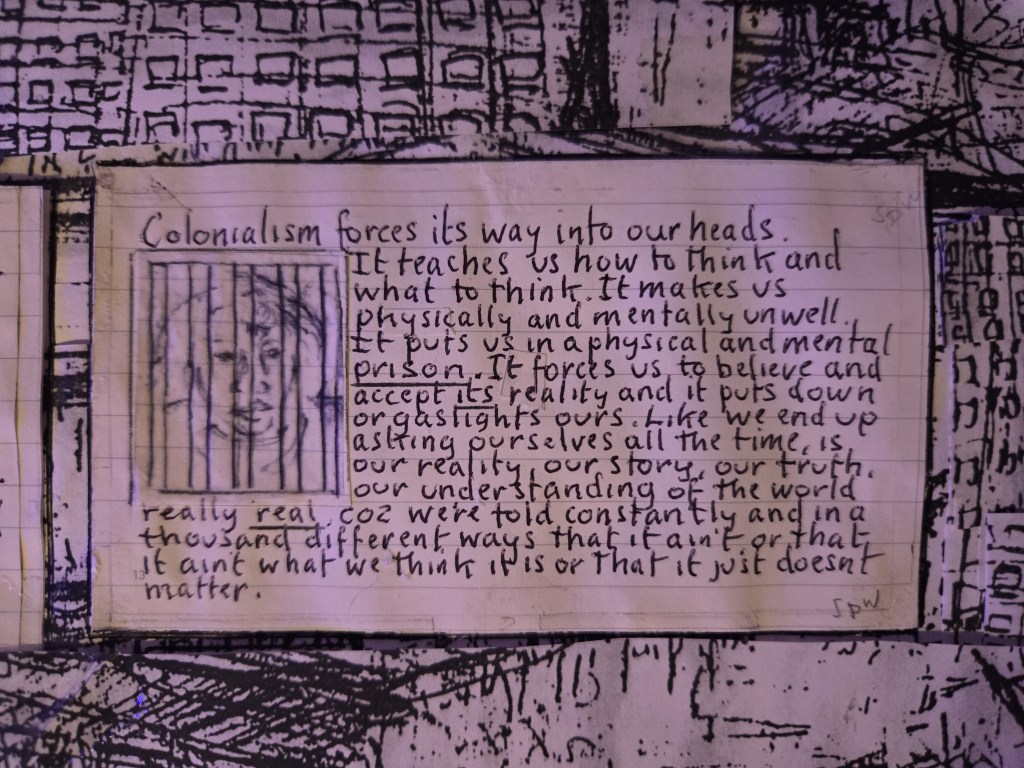
Colonial/colonizing education dictates and imposes through force, threats, silencing tactics, denial, neglect, punishments, rewards and manipulation, the stories that can be told, what can be said and how it can be said. It works to shut down any possibility for the children and youth of the historically oppressed to organize and to agitate to transform their world or for them to gain a knowledge of self beyond those that it approves of or those that will make the oppressive colonial system that gave birth to it more comfortable, more stronger, more normalized. It limits and controls what is possible in thought and action. The Panthers knew this. They opposed and defended the community against all of this violence and more. They did it through their liberation schools and their breakfast programs and through their flagship liberation school the Oakland Community School (OCS). And like Elaine Brown, the former leader of the Black Panther Party told us recently, the OCS didn’t teach students ‘what to think’, it taught them ‘how to think’.
What this meant was that students would come to develop alternative and opposing anti-colonial ways to know, ways to do, and ways to be that were rooted in the concepts of collective anticolonial self-defense and collective anticolonial liberation. They would learn how to analyze, question and interrogate the language and the concepts that systems of oppression use to dominate. They would learn how to oppose and defend themselves against this domination and in doing so they would learn the importance of inventing their own language and their own concepts of collective resistance. They would learn that everything is connected and interrelated and so they would learn how to build relationships on those terms. They would learn about the racist, colonial, capitalist system and structure. What it was and is. They would learn how to identify it and how it tricks us into doing damage to ourselves by pitting us against each other or by making us dependent on it by making us feel and believe that we are inferior or less than.
Collectively the students would come to understand who and what was the real enemy and what they must fight back against and what they must defend themselves against as opposed to (individually) fighting against each other and seeing each other as the enemy. What was crucial was that the liberation schools (especially the OCS) nurtured in the children and youth the unswerving belief that they (and the communities they came from and the oppressed as a whole) HAD POWER. So its not the system (this thing that tries to control our lives that we have come to know through our everyday experience as a very real thing even though we might not be able to name it) that has power. Neither is it the wealthy or the landlord, or the police, or the politician, or the courts or the colonial and colonizing teachers and their schools and the people that run them or those that take and occupy our lands and our waters, or those who exploit and force our parents to work for nothing in dangerous and unsafe conditions, or those who make us homeless, or those who can bang on our doors uninvited and take us away from our mothers and fathers and families that has power. Its not them that holds power. Nah! WE HAVE POWER. WE HOLD POWER. ALL OF US, ‘ALL POWER TO ALL PEOPLE’. We the children and youth of the oppressed. We the community. We the collective. We the People. We the oppressed everywhere. We have power. We hold power. The power to oppose, the power to determine who we are, the power to determine how we want to live our lives, the power to determine what we want in the now and what we want our futures to look like. This is the fire that ignites the revolutionary consciousness: This is the fire that reclaims and seizes back our lives.
We believe this is beyond important. We believe this is life and death, the life of ourselves collectively or the death of ourselves collectively. We believe that a sense of helplessness and hopelessness forms when we as historically oppressed peoples already traumatized, hurt, wounded and disconnected from ourselves and everything that we are related to by oppression itself are made to believe that we are powerless, that we do not have the power to oppose injustice, that we do not have the power to transform our conditions, our circumstances and our world for the better on our own terms. Under these conditions we might look to relieve the pain of it all in ways that do harm to our bodies as individuals and collectives (and we know this is a natural response). Other times we might be forced into fighting each other in the competition, scramble and struggle for survival in this colonial and colonizing world that we have been born into (again a natural response). The end result is almost always the same. The oppressed as a community implodes and falls apart and is pushed into what the Panthers understood from reading comrade Frantz Fanon as a kind of forced collective suicide. And so this is a life and death issue for the historically oppressed. When children and youth are worn down, demoralized, rendered helpless, forced into a state of hopelessness, and made to believe from the get-go that they have no power to oppose the oppression and injustice that they and their families and their communities are faced with it is unlikely that they/we will develop a revolutionary consciousness. If they/we cannot develop a revolutionary consciousness they/we are unlikely to become revolutionaries in the future. If they/we cannot become revolutionaries in the future the current system will remain unopposed. If the current system remains unopposed the conditions of life and living for the historically oppressed as collectives and as Peoples in all of their diverse complexity can never change. They can only get worse. The collective future for the historically oppressed and the planet as a whole will be one of continuous exploitation, persecution, misery and a daily collective externally imposed death. That’s what the late Panther and political prisoner ‘Chip’ Fitzgerald meant when he coined the term ‘social death’. This is the basis for Huey’s concept of ‘revolutionary suicide’. Better to be prepared to die a revolutionary death in the fight for liberation ’cause to do nothing is to surrender to this physical, psychological, emotional colonial and colonizing everyday death that impacts us all.
We believe that this violence and this surrender is what the colonial and imperialistic system and the kind of education that it throws up and imposes on the children and youth of the oppressed (and all peoples for that matter) wants, produces, and wants the oppressed to accept as normal and so we step in, we intervene. We oppose. We fight-back. We do this as an act of self-defense. Like the Panthers our self-defense is an anti-colonial self-defense. We oppose all things colonial. We oppose all things colonizing. We oppose all things imperialist. Like the Panthers we believe in collective self-defense and collective liberation. This drives our understanding of what is sometimes talked about in teaching and learning circles as ‘pedagogy’. Dictionary definitions talk about ‘pedagogy’ as the ‘practice’ or the ‘act’ or the ‘art’ or the ‘method’ or the ‘science’ of teaching and learning. Some talk about it as if its some kind of teaching tool that can be taken out of a drawer or a ‘toolbox’ to ‘manage’ a specific group of students with specific needs. But none of these definitions has anything to say about collective survival, collective thriving and collective resistance to colonial oppression and colonial death as the everyday revolutionary practice of life, living and love for the collective self and so they have no meaning for us. We follow what Lilla Watson the Australian Indigenous activist said many years ago: “If you have come to help me, you’re wasting your time. But if your liberation is bound up with mine then let us work together”. We believe that this work and liberation itself can only be achieved through the nurturing and growth of a collective revolutionary consciousness. This is at the heart of our understanding of self-defense and at the heart of our pedagogy of self-defense. The life and death of the oppressed depends on this. Our language of communication is a collective anticolonial language. It is the political language of the oppressed. Our partners in the struggle and joy of coming to liberation and revolution are not students. They are comrades.
As their revolutionary consciousness grows our comrades come to know themselves and come to believe in themselves as “comrades” and in doing so they and all of we collectively come to know the power of language whether seized back from the oppressor or invented by ourselves for the purpose of revolution, liberation, anticolonial self-defense and for becoming new Peoples and new beings. Our comrades come to know the anticolonial meaning of ‘comrades’ that we are all partners in struggle, that I will defend you and you will defend me as collectives coz all a we are one and all a one is we. That is our pedagogy. That is the pedagogy of self-defense. The defense of everything that we are related to and everything that is related to we. That’s the pedagogy that brings connectedness out of dis-connectedness. That’s the pedagogy that brings power-FULLNESS to our collective souls and our collective hearts. That’s the pedagogy that is clued into revolution as a lived and living reality.
Copyright(c) 2025 Stan Doyle-Wood: Member of The Protege Panther Project for Self-Defense. All rights reserved: The Protege Panther Project for Self-Defense
EVERY ATOM OF POWER TO EVERY ATOM OF THE PEOPLE
 The Protege Panther Project for Self-Defense